When talking to other event professionals and marketers, the conversation has shifted from venue aesthetics to verifiable revenue. For too long, we have allowed ourselves to be seduced by the comfort of vanity metrics. We boast about a room full of people or a spike in social media followers, yet 70% of event professionals still hit a wall when the boss asks for a direct line to the balance sheet.
The reality is that 84% of our peers are still stuck in a cycle of collecting basic badge scans. It feels productive in the moment, but it’s essentially the event equivalent of "thoughts and prayers." It doesn't pay the bills, and in 2026, it certainly doesn't justify a budget.
From vanity to velocity
If we want to close the attribution gap, we have to borrow a page from the SaaS playbook. In the tech world, nobody cares about a sign-up if it leads to immediate churn. They care about Customer Lifetime Value and Pipeline Velocity. We should be no different.
When we look at the data, the true impact of a corporate gathering doesn't expire when the lanyards are binned. High-intent metrics tell a much more sophisticated story:
|
Low-Intent (The Vanity)
|
High-Intent (The Action)
|
The Strategic Outcome
|
|
Total Social Media Followers
|
Brand Sentiment and Recall
|
Market Position Growth
|
|
Raw Session Attendance
|
Dwell Time and Content Resonance
|
Audience Authority
|
|
Total Badges Scanned
|
Sales Qualified Leads (SQLs)
|
Pipeline Velocity
|
|
Email Open Rates
|
Churn Reduction
|
Customer Lifetime Value
|
The 90-day truth about B2B engagement
The mistake most SMEs make is trying to calculate ROI the Monday after the event. According to the 90-Day Rule often used in software circles, the highest value from an in-person interaction usually materialises between 30 and 90 days post-event.
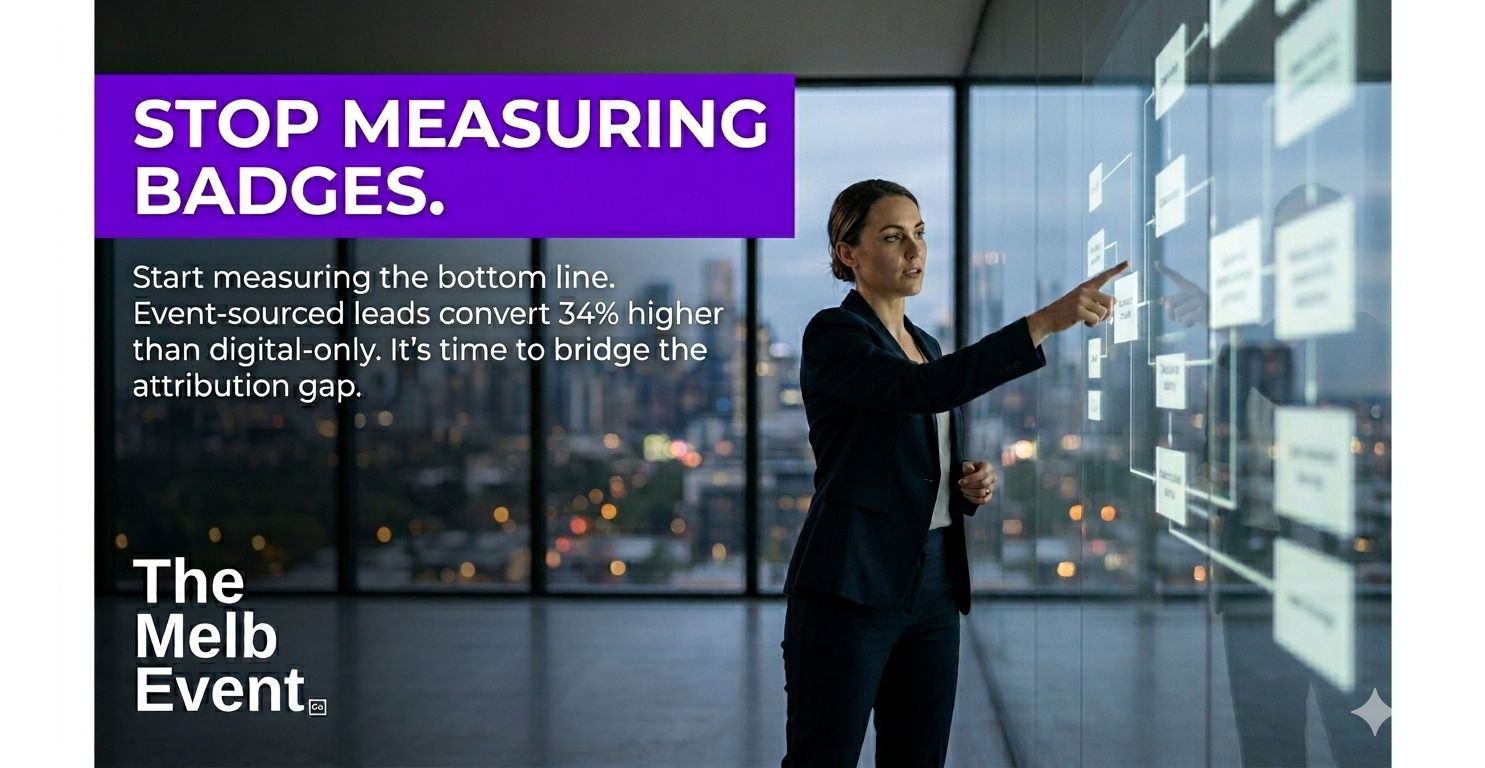
In a complex B2B environment, decisions aren't made over a single canapé. However, event-sourced leads convert to opportunities at a 34% higher rate than those generated through digital-only channels. The event isn't just a party; it’s an accelerant. If you aren't tracking the attendee journey from that first invitation to the final signed contract three months later, you are essentially losing 70% of your event’s value in your reporting.
Implementing the Net Event Score
To bridge this gap, we need to adopt a Net Event Score (NES). Think of this as a leading indicator of revenue. By measuring attendee sentiment and specific intent to purchase immediately after a session, we can forecast revenue with far more accuracy than a simple "thanks for coming" survey ever could.
We have to stop treating our guests as data points to be scanned and start treating them as a cohort to be nurtured. Whether you are an industry association or a mid-sized charity, the mandate remains the same: stop counting heads and start counting the impact those heads have on the long-term health of your organisation.
.png?width=200&height=200&name=The%20Melb%20Event%20(1).png)
.png?width=1700&height=800&name=New%20Blog%20Post%20sizes%20(2).png)
.png?width=48&height=48&name=Untitled%20design%20(30).png)
